
Stop Revenue Leaks Before the First Appointment: Eligibility and Authorization at Intake
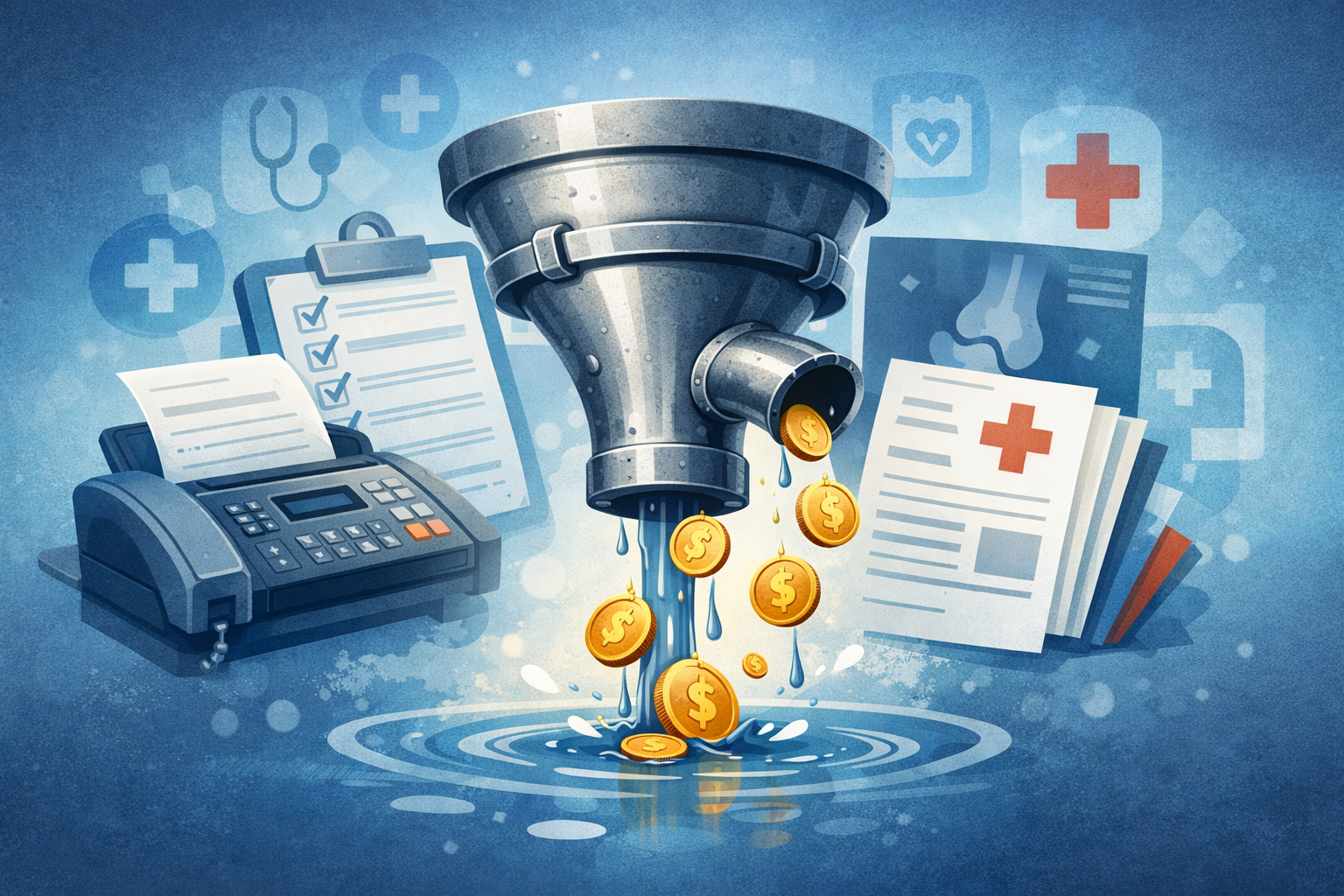
Stop Revenue Leaks Before the First Appointment: Eligibility and Authorization at Intake
When revenue leaks begin before care even starts, it’s easy to blame reimbursement cuts or payer negotiations. But clinic leaders know that the leak often starts at the front door. A referral arrives via fax with missing documents and unverified insurance; days pass while staff chase paperwork; and by the time the patient could be scheduled, someone else has already admitted them.
“Why are we losing money before a single service is delivered?”
The answer isn’t just speed. In many clinics, the intake process lacks the safeguards that protect revenue. Research shows that roughly 75 % of medical institutions in the United States still rely on fax communication\[1\] and that even in regions where e‑referrals are widely available, 88 % of doctors still use fax to share patient information\[2\]. When referrals arrive on paper, incomplete and disconnected from eligibility checks, denials and leakage follow.
In this post we’ll unpack how inadequate intake processes create revenue leaks, why eligibility and authorization work must happen before the first appointment, and what a modern referral workflow looks like. If your clinic has ever lost a patient because of missing Face‑to‑Face (F2F) documentation or late NOA filings, keep reading.
The Revenue Leak You Don’t See: Intake Failures
Most clinics track denials in billing reports but don’t connect them back to intake workflows. The classic leaks look like this:
* Incomplete insurance information. Referrals arrive without insurance cards or authorization forms. Staff schedule appointments on good faith, only to discover that the payer won’t cover the service or requires prior authorization.
* Missing F2F or NOA documentation. In home‑health and specialty programs, a single missing signature can wipe out reimbursement. Without early checks, staff often discover omissions after the encounter.
* Delays that drive patients elsewhere. Without automated capture and triage, referrals sit in a fax tray over the weekend. By the time staff calls, the patient has been admitted by a competitor. Some industry reports estimate that only about half of faxed referrals convert to scheduled appointments, and the average time from referral to appointment can stretch to 21 days—numbers that echo what many coordinators experience anecdotally.
* Duplicate data entry and manual errors. When coordinators re‑type demographics and insurance data into the EMR, mistakes sneak in. Incorrect subscriber IDs or dates of birth lead to denials that could have been prevented.
These aren’t billing team problems; they’re intake problems. When the front door is porous, the revenue cycle leaks before it begins.
If your team hasn’t documented the intake process in detail, start with the basics. Our documentation explains how referrals are captured, parsed and routed in a unified queue. Even a quick read will give you ideas for tightening your own workflow.
If your team hasn’t documented the intake process in detail, start with the basics. Our documentation explains how referrals are captured, parsed and routed in a unified queue. Even a quick read will give you ideas for tightening your own workflow.
Where It Breaks: Incomplete Referrals and Guesswork
Specialty clinics are awash in PDFs, scanned lab results and scribbled notes. Even high‑tech practices still receive most inbound referrals via fax\[1\]. The burden of turning these pages into structured data falls on intake staff who are already juggling voicemails, portal messages and walk‑ins.
Imagine a patient referred for rheumatoid arthritis. The referral contains a single line—“joint pain, positive ANA.” There’s no insurance card, no medication list, no recent lab values. Staff members:
- Guess urgency. Without guidelines, they decide whether the patient can wait weeks or needs to be seen tomorrow.
- Call for missing documents. They leave voicemails for the referring office and request lab results via fax.
- Manually re‑enter data. They key demographics into the EMR and schedule an appointment without verifying eligibility.
Two weeks later, they finally obtain the labs. Unfortunately, the patient never arrives—the referring office re‑sent the referral elsewhere because they couldn’t wait.
This isn’t an extreme story; it’s what happens when the only control is human memory. Incomplete referrals and manual triage invite leakage.
Why Eligibility and Authorization Must Happen Upfront
Many clinics run insurance eligibility checks days before the appointment. By then it’s too late. Eligibility and authorization should be integral to intake for three reasons:
- Prevent avoidable denials. Payers often deny claims because coverage ended, benefits were maxed out or the service requires prior authorization. Verifying eligibility at intake ensures staff only schedule patients who can be covered—or at least know they’ll need to collect cash or initiate an authorization request.
- Surface high‑risk cases. Patients with complex insurance (e.g., Medicare Advantage, Medicaid managed care) often require extra steps. Early checks flag those cases so coordinators can request F2F documentation or plan for longer authorization timelines.
- Stop patient leakage. When eligibility is confirmed and benefits are clear, staff can provide confident scheduling dates. Patients don’t drift to another provider because of uncertainty.
A Contrarian Insight: Speed Isn’t Enough
It’s tempting to think that automating referral intake is about speed. Speed matters, but completeness matters more. Capturing, parsing and routing a referral in seconds isn’t helpful if you still schedule a patient whose insurance is inactive. A thoughtful intake workflow prioritizes quality and completeness over raw throughput. That means systematically checking for missing documents and verifying coverage before the case ever hits a scheduler’s desk.
Building a Revenue‑Safe Intake Workflow
Here’s what a modern referral intake system looks like:
- Unified capture across channels. Fax, email and portal referrals feed into a single queue. Automation parses PDFs and extracts demographics, diagnoses, orders and insurance details. In our platform, this happens before staff even open the inbox, turning messy documents into structured data.
- Missing‑data detection. The system flags absent fields—insurance card, F2F documentation, referring provider ID—so coordinators know exactly what to request. Automated messaging sends a secure link to the referrer or patient to upload missing items.
- Real‑time eligibility verification. With connections to payer databases, the system checks coverage, copay and deductible status on the spot. Cases that fail verification are held until staff can follow up.
- AI‑assisted triage. Configurable rules and machine learning score urgency based on diagnosis codes, age and clinician‑defined criteria. Urgent cases surface first; routine cases are scheduled accordingly; ambiguous cases route to a reviewer.
- Integrated prior authorization workflows. For services requiring authorization, the system generates payer‑specific forms, pulls relevant clinical data and initiates requests automatically. Staff receive alerts when approvals come through.
- EMR synchronization. Validated referral data flows into the EMR, creating or updating patient records without double entry. Staff operate from a single source of truth.
When eligibility and authorization happen within the intake flow, denials drop dramatically. Clinics report fewer write‑offs from missing documentation and more predictable cash flow.
Monday‑Morning Checklist: How to Plug Your Revenue Leaks
You don’t need to replace your EMR to start fixing intake leaks. Here’s a practical plan you can start next week:
- Map your front‑door workflows. Identify every way referrals arrive—fax, email, portal, phone—and who handles each. Look for bottlenecks and duplicate entry.
- Create a minimum required data set. Define which fields must be present before a referral can be scheduled (e.g., patient demographics, insurance policy number, referring provider NPI, diagnosis, urgency notes). Train staff to hold incomplete referrals until those fields are captured.
- Run eligibility before scheduling. Use online payer portals or clearinghouses to verify coverage at the moment you create the case. If coverage is uncertain, pause scheduling and request additional insurance details.
- Establish triage guidelines. Work with physicians to define rules for urgency. For example, any referral with “chest pain” or “new neurological deficit” should be seen within 48 hours; stable cases can wait two weeks. Document these rules and integrate them into your intake software.
- Automate document collection. Provide referring offices and patients with secure upload links for insurance cards and F2F forms. Automate reminders so staff aren’t chasing faxes.
- Review denials monthly. Connect denial codes back to intake steps. If you see repeat issues with missing NOA documentation or expired coverage, adjust your minimum data set and training accordingly.
By standardizing intake and front‑loading eligibility checks, you convert more referrals into revenue and give patients a smoother experience. As the JMIR study notes, shifting away from fax and integrating digital referrals requires change management\[3\]—but the payoff is fewer leaks and less frustration for both staff and patients.
Frequently Asked Questions
What causes revenue leakage in referral intake?
Revenue leaks often stem from incomplete insurance information, missing F2F or NOA documentation, and delays caused by fax‑based workflows. When referrals lack necessary data, staff either schedule patients who aren’t covered or lose them to other providers, leading to denials and lost revenue.
How does insurance eligibility verification work at intake?
Eligibility verification connects directly to payer databases to confirm coverage, copay and deductible status before scheduling. This process ensures that services are billable and flags cases requiring prior authorization, preventing denials downstream.
Do we need a new EMR to implement automated intake?
Not necessarily. Modern intake systems integrate with popular EMRs via open APIs. They capture and parse referral data, verify eligibility and push validated information into the EMR, eliminating duplicate data entry without replacing your existing system.
Isn’t automation just about speed?
Speed is important, but completeness is critical. A fast referral capture that skips eligibility or documentation checks simply accelerates denial. Effective automation prioritizes data quality and compliance while still moving quickly.
How can our clinic transition away from fax?
Adoption requires both technology and change management. Start by providing referrers with electronic options (secure portal, email‑to‑fax bridge). Use middleware that bridges fax and digital referrals so you can handle both during the transition. Over time, encourage referring partners to use digital channels by demonstrating faster turnaround and fewer headaches\[3\].
Ready to Stop the Leak?
Referral intake isn’t just the starting point of care—it’s the beginning of your revenue cycle. By embedding eligibility and authorization into intake, clinics can prevent denials, reduce patient leakage and free staff to focus on care instead of chasing paperwork.
If you’re ready to see how IntakeDesk can help your team capture every referral and verify coverage in seconds, book a demo today. Our team will walk you through unified capture, eligibility checks and smart triage—so your revenue stays where it belongs.