
Automated Referrals in 2026: Why Specialty Clinics Need Intake Infrastructure, Not Just Digital Fax
Automated Referrals in 2026: Why Specialty Clinics Need Intake Infrastructure, Not Just Digital Fax
For years, healthcare organizations have tried to modernize referral intake by replacing paper with digital tools. In many cases, that meant moving from physical fax machines to digital fax inboxes, from paper folders to PDFs, and from scattered intake steps to slightly more centralized document handling.
That progress helped, but it did not solve the deeper problem.
Many specialty clinics still struggle with the same operational issues they faced before digitization: incomplete referrals, delayed follow-up, manual review, inconsistent triage, late eligibility checks, patient outreach bottlenecks, and limited visibility into where referrals stall or disappear.
That is why referral intake automation has become such an important market conversation in 2026.
The real shift is no longer about receiving referrals electronically. It is about turning referral intake into structured, connected, measurable workflow infrastructure. For specialty clinics, that distinction matters. Referral intake is not just an administrative function. It is the front door to care, the beginning of revenue capture, the starting point of patient communication, and in many cases, a determinant of how quickly and safely a patient gets where they need to go.
The clinics that win the next phase of growth will not be the ones with the cleanest digital inboxes. They will be the ones that build real intake infrastructure.
The Market Shift: From Document Receipt to Intake Infrastructure
The automated referral market is maturing.
What used to be treated as a narrow document-ingestion problem is increasingly being recognized as a broader operational challenge. Healthcare organizations do not just need to receive referrals faster. They need to process them more intelligently, move them more consistently, and make them more visible across teams and systems.
That has changed the market conversation.
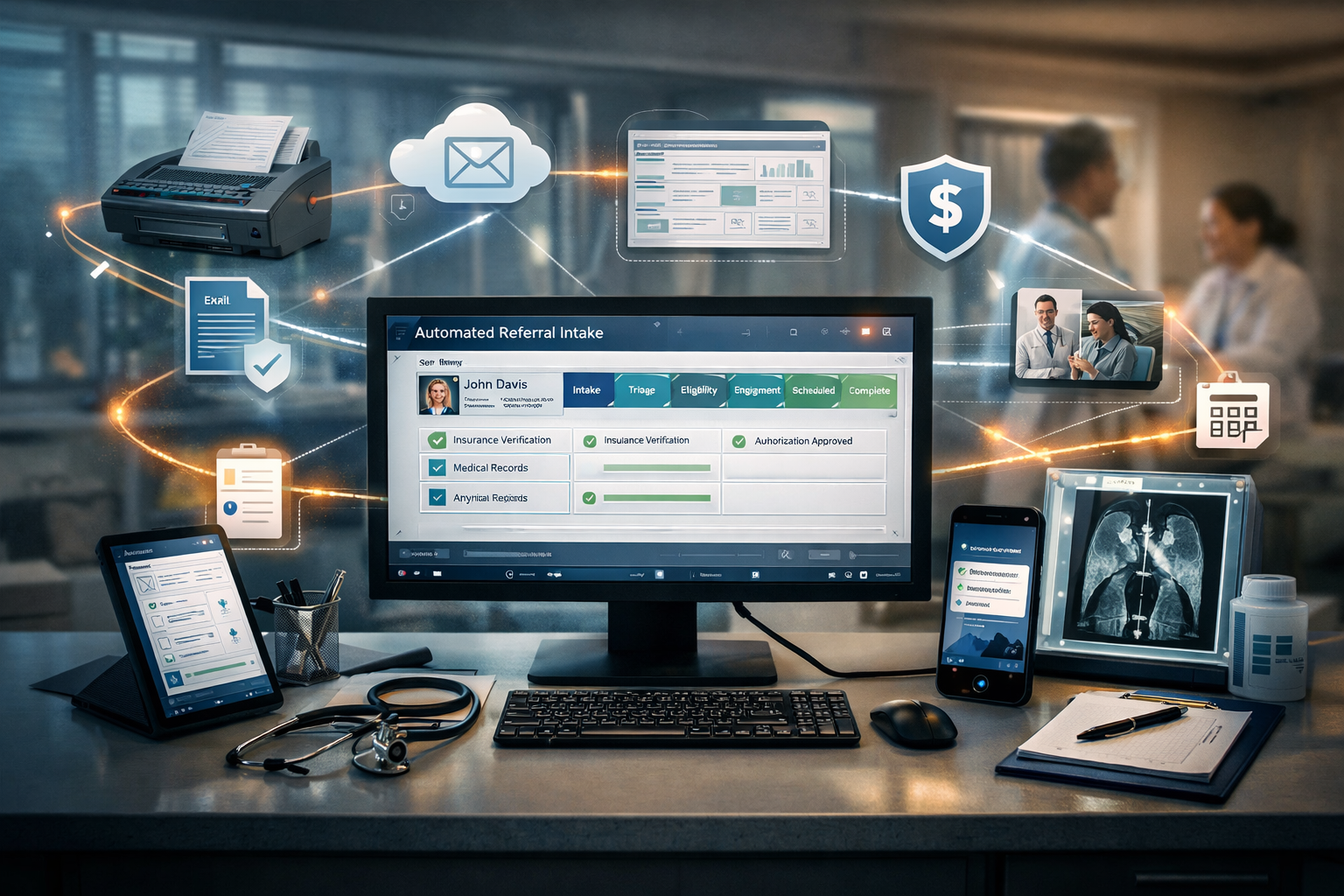
Today, the most important referral automation discussions are no longer centered on whether a clinic can digitize fax intake. They are centered on whether a clinic can orchestrate the full referral journey from first receipt through scheduling readiness and downstream integration.
That includes:
• capturing referrals from multiple inbound channels
• extracting usable data from unstructured packets
• identifying urgency and routing needs
• validating insurance and authorization readiness
• engaging patients with clear next steps
• integrating into EMR and operational workflows
• measuring performance, bottlenecks, and leakage over time
This is the difference between a tool that stores incoming work and a system that advances incoming work.
That is the real category shift now happening across automated referrals.
Why Digital Fax Alone Is No Longer Enough
Digital fax solved one problem: paper handling.
It did not solve orchestration.
A clinic may no longer have stacks of paper sitting next to a machine, but if staff still need to manually open documents, locate key information, classify referrals, identify missing records, decide what is urgent, perform follow-up, and key details into downstream systems, then the core operational burden remains.
The medium has changed. The workflow has not.
That is why so many organizations still feel stuck even after adopting “digital” intake tools. They digitized receipt, but not the full intake process. The result is often a cleaner-looking version of the same chaos.
Why Specialty Clinics Still Feel the Pain
Specialty clinics deal with a more complex version of referral intake than many other care settings.
A referral is rarely just a handoff. It may involve diagnosis-specific requirements, specialty fit questions, clinical review needs, payer restrictions, missing labs or imaging, urgent symptom patterns, or authorization prerequisites that must be addressed before a patient is truly ready to schedule.
That makes specialty referral intake more than clerical work. It is operational interpretation. It is care access management. It is financial readiness screening. And sometimes, it is a patient safety function.
When those responsibilities are handled through disconnected systems and manual review, predictable problems begin to appear.
Incomplete Referrals Slow Down the Entire Workflow
One of the most common breakdowns in specialty intake is incomplete information. Referral packets may arrive missing clinical notes, insurance details, medication context, imaging, lab results, demographics, or specialty-specific documentation required for next steps.
If those gaps are not identified immediately, the clinic does not discover them until later in the process, after valuable time and effort have already been spent.
That creates:
• duplicated work
• delayed patient outreach
• slower scheduling readiness
• increased burden on intake staff
• poor follow-through with referring offices
In other words, the workflow becomes expensive before it becomes productive.
Manual Review Creates Hidden Capacity Limits
Intake teams are often asked to process complex referrals using tools that still require too much human interpretation. Every referral must be opened, reviewed, understood, categorized, and advanced by a person before the next meaningful step can happen.
That creates a hard operational ceiling.
As referral volume rises, throughput rises only if staffing rises with it. Even then, performance can remain inconsistent because the work depends so heavily on individual judgment, memory, and queue management.
A clinic may think it has a staffing problem when in reality it has a workflow-structure problem.
Urgent and Routine Cases Get Mixed Together
Without structured triage, all referrals tend to enter the same operational lane.
That means a clinically urgent case can end up sitting beside a routine referral simply because both arrived at the same time. Unless a staff member manually recognizes the difference and escalates it appropriately, the system treats them too similarly for too long.
That is risky.
Specialty referral intake needs the ability to distinguish between:
• urgent and routine cases
• complete and incomplete packets
• appropriate and misrouted referrals
• schedule-ready and not-yet-ready patients
• standard and exception-based workflows
A system that cannot make those distinctions early creates delay where the organization can least afford it.
Financial Readiness Often Happens Too Late
In many clinics, insurance validation, benefit review, and authorization readiness begin only after a referral has already consumed considerable staff time.
That creates false progress.
A patient may appear to be moving through intake when, in reality, payer-related issues will soon force the workflow backward. Staff time is spent coordinating a patient who is not yet ready to move forward, while patients who could be advanced more quickly remain trapped in the same undifferentiated queue.
Financial readiness should not be treated as a downstream correction. It should be part of intake design.
Patients Experience Silence at the Worst Possible Time
The period immediately after a referral is sent is one of the most uncertain parts of the patient journey.
Patients often do not know:
• whether their referral was received
• whether records are complete
• whether insurance has been reviewed
• what the next step is
• whether they need to upload or confirm anything
• when they should expect follow-up
If communication depends entirely on manual outreach, patients often experience silence precisely when reassurance and clarity matter most.
That silence creates frustration, confusion, and loss of momentum.
Leadership Lacks True Visibility Into Referral Performance
Many specialty organizations still cannot answer important operational questions quickly or confidently.
They struggle to measure:
• how many referrals were received by source
• how many were incomplete at intake
• how long referrals wait before first touch
• where referrals most commonly stall
• which payers create the most friction
• which referring offices send the cleanest documentation
• how many referrals convert to scheduled visits
• how many referrals leak out of the process entirely
Without that visibility, improvement becomes reactive. Teams know the system feels overloaded, but they cannot always see precisely why.
Still treating referrals like documents instead of workflows?
IntakeDesk helps specialty clinics capture referrals, extract key data, surface missing information, support triage, and move patients forward with less manual friction.
What Automated Referral Infrastructure Must Actually Do in 2026
The next generation of referral automation needs to be built around real operational outcomes, not just cleaner document receipt. To create meaningful impact, it must reduce ambiguity, accelerate readiness, and turn incoming demand into visible, structured workflow.
That requires more than a single feature.
It requires coordinated infrastructure.
Capture Referrals From Every Real-World Channel
Healthcare still runs through a mix of legacy and modern inputs. Referrals may arrive through fax, digital fax, email, uploaded files, referral portals, electronic documents, scanned records, or forwarded messages from staff.
A modern intake platform has to accept that reality.
The goal is not to force every referrer into one ideal channel before improvement can begin. The goal is to make every incoming referral visible, trackable, and actionable regardless of how it arrived.
The first step in modernizing intake is not eliminating complexity overnight. It is organizing complexity into one operational layer.
Extract Structured Data Early in the Workflow
This is one of the most important capabilities in modern referral automation.
If a referral arrives digitally but still requires a staff member to manually find patient demographics, diagnosis information, payer data, referrer information, document completeness, and clinical context before any real workflow can begin, then automation has not gone far enough.
True intake infrastructure converts unstructured referral content into structured data early enough to matter.
That structured data becomes the basis for:
• routing
• prioritization
• queue assignment
• rules evaluation
• eligibility workflows
• patient communication
• integration into EMR and reporting systems
Without this step, digitization remains superficial.
Apply Intelligent Triage, Not Generic Queueing
Referral automation without triage is just faster accumulation.
Specialty clinics need systems that can help distinguish what should happen next, how fast it should happen, and whether a referral is truly ready to move forward.
That means applying logic that can identify:
• urgency
• specialty alignment
• documentation completeness
• missing requirements
• appropriate escalation pathways
• cases that require human review
• cases that can move forward through standard workflow
The point is not to remove human judgment. The point is to reserve human judgment for the moments where it is most valuable, instead of consuming it on repetitive intake sorting.
Good triage design protects both access and safety. That is why smart intake triage matters so much in specialty referral workflows.
Move Eligibility and Authorization Readiness Upstream
One of the clearest trends in the automated referral market is the movement of financial-readiness work closer to the front of the intake process.
That is the right direction.
A clinic gains little by advancing a referral operationally if payer issues, coverage gaps, or authorization needs are only discovered after the patient appears close to scheduling. That creates delay, rework, and frustrated staff.
Modern referral automation should help bring upstream visibility to:
• insurance verification
• payer classification
• benefit-readiness checks
• prior authorization requirements
• missing payer-related documentation
• workflows that require manual financial review
This is where intake operations and revenue discipline begin to align. Modern intake design should moves insurance eligibility and authorization workflows upstream instead of treating them as downstream cleanup.
Start Patient Engagement Earlier
Modern intake should not wait for a coordinator to become available before momentum begins.
Patients should be able to receive clear next steps early in the process, including prompts to confirm information, upload documents, complete required intake tasks, or understand referral status.
Early engagement helps reduce:
• manual follow-up burden
• patient uncertainty
• unnecessary call volume
• intake abandonment
• delays caused by uncollected information
It also creates a better first impression. For specialty clinics, that matters. Referral intake is often the patient’s first operational experience with the organization.
Early digital outreach works best when it is part of a broader patient intake workflow rather than a manual afterthought.
Integrate With EMR, Scheduling, and Operational Systems
A referral platform cannot create durable value if it remains isolated from the rest of clinic operations.
For intake automation to become true infrastructure, it must connect with downstream systems that shape the patient journey and the clinic’s internal work.
That may include:
• EMR or EHR chart creation
• patient record synchronization
• scheduling workflows
• task creation
• case management steps
• document delivery
• analytics and operational reporting
The goal is continuity. Intake should not become another silo. It should become the structured entry point that makes downstream systems cleaner and more effective.
Make the Entire Process Measurable
Operational improvement depends on visibility.
A modern referral platform should allow leadership, intake teams, and operational stakeholders to measure performance with confidence across the full workflow.
That includes metrics such as:
• referral volume by source
• time to first touch
• time to schedule readiness
• completeness rates
• backlog volume by status
• referral conversion rates
• patient engagement rates
• payer friction patterns
• referral leakage points
• workload distribution across teams
When referral operations become measurable, they become manageable. That is when organizations move from anecdotal frustration to actual process control.
Intake automation should do more than digitize fax
The real opportunity is building a workflow that captures, triages, validates, engages, integrates, and measures every referral from first touch forward.
Where IntakeDesk Fits in This Shift
This is why is so aligned with the direction of the market.
The platform is not framed as a simple document repository or a narrow fax-ingestion tool. It is positioned around the broader operational realities of specialty referral intake: unified capture, AI-assisted parsing, smart triage, insurance workflows, patient engagement, downstream integration, and visibility into performance.
That matters because the market no longer needs a better inbox.
It needs systems that can help specialty clinics do the following at the same time:
Unify Referral Intake Across Channels
Specialty clinics need one place to receive, organize, and act on referrals across fax, email, portal traffic, and uploaded documentation.
Turn Incoming Documents Into Actionable Workflow
It is not enough to capture records. Clinics need structured information that can drive the next step without waiting on repeated manual interpretation.
Support Triage and Readiness Work Earlier
Organizations need tools that surface missing information, identify urgency, and move insurance and intake-readiness work forward before scheduling becomes blocked.
Improve Patient Access Without Adding Administrative Drag
Patient engagement, intake completion, and communication should be part of the intake engine, not bolted on after manual review.
Integrate and Measure
The strongest intake platforms are the ones that do not end at receipt. They connect downstream and make referral performance visible across the organization.
That is the real promise of modern automated referrals, and it is where IntakeDesk is positioned to add value.
Questions Specialty Clinic Leaders Should Be Asking Now
As more referral-automation vendors enter the conversation, clinics need a more disciplined way to evaluate what they are actually buying.
The right question is not whether a platform can receive a referral.
That is baseline functionality.
The real evaluation questions are deeper.
Can It Unify Every Realistic Referral Channel?
If referrals can still arrive through multiple pathways, the platform must be able to consolidate them into a single operational intake flow.
Can It Turn Unstructured Packets Into Structured Data?
If staff still need to interpret every referral manually before work can begin, the platform is not truly reducing intake complexity.
Can It Identify What Is Missing and What Is Urgent?
The system should help distinguish complete from incomplete, routine from urgent, and aligned from misrouted before delays compound.
Can It Bring Financial Readiness Earlier Into the Process?
Eligibility and authorization work should not be an afterthought if the clinic wants to reduce friction and improve conversion.
Can It Engage Patients Before Staff Have To Chase Them?
Early digital engagement helps preserve momentum and reduces repetitive outreach work.
Can It Integrate Instead of Creating Another Silo?
Intake platforms should strengthen downstream operations, not isolate intake into a disconnected side workflow.
Can It Show Us Where Referrals Stall, Leak, or Convert?
If leadership cannot clearly see performance, backlog, and referral outcomes, improvement will remain guesswork.
These are the questions that separate feature buying from infrastructure building.
The Bigger Opportunity: Redesigning How Access Begins
This is the broader opportunity in front of specialty care.
Automated referrals are not just about reducing administrative effort, though they absolutely can. Their bigger value is that they allow organizations to rethink how patient access begins.
When referral intake becomes structured, consistent, and measurable:
• urgent patients can be surfaced faster
• routine patients can move more predictably
• incomplete referrals can be flagged earlier
• payer friction can be addressed sooner
• staff can spend more time on exceptions and less on repetitive clerical work
• referring offices can experience better follow-through
• patients can receive more timely communication
• leaders can see where to improve before bottlenecks become crises
That is not simply efficiency.
That is better operational care design.
In many specialty settings, access issues are not caused only by provider capacity constraints. They are also caused by intake friction, delayed readiness, inconsistent communication, and invisible operational leakage. When clinics fix those upstream issues, they often improve much more than speed. They improve reliability.
Final Thoughts: The Future of Automated Referrals Is Workflow, Not Inbox Management
The automated referral market is growing because healthcare is finally naming the problem correctly.
Referral intake has always been more than a document-handling task. It is infrastructure. It shapes access, readiness, communication, operational workload, and conversion from the very first touchpoint.
That reality changes how specialty clinics should evaluate the category.
The future will not belong to tools that simply digitize incoming paperwork.
It will belong to platforms that can:
• capture referrals across real-world channels
• extract meaningful data from messy documents
• apply triage logic intelligently
• move eligibility and authorization readiness earlier
• engage patients before momentum is lost
• integrate cleanly with downstream systems
• make performance visible across the full intake journey
That is the standard the market is moving toward.
And for specialty clinics that want to reduce friction, protect patient access, improve referral conversion, and scale more intelligently, that is the standard that matters.
Frequently Asked Questions
What is automated referral intake?
Automated referral intake is the process of capturing incoming referrals from channels such as fax, email, portals, and uploaded documents, then converting those referrals into structured workflow. A strong automated intake process helps clinics extract key information, identify missing items, support triage, validate readiness, engage patients, and move referrals toward scheduling with less manual effort.
How is automated referral intake different from digital fax?
Digital fax helps clinics receive and store documents electronically, but it does not automatically create structured workflow. Automated referral intake goes further by turning incoming documents into usable data, routing work appropriately, surfacing missing information, supporting triage, and helping teams move referrals forward instead of just storing them.
Why do specialty clinics need referral automation?
Specialty clinics often manage more complex referrals that require clinical review, documentation completeness, payer validation, and specialty-specific routing. Referral automation helps reduce manual review, improve visibility, support earlier readiness checks, and create a more reliable process for moving patients from referral receipt to scheduled care.
What should a modern referral intake platform do?
A modern referral intake platform should capture referrals from multiple channels, extract structured data from unstructured documents, identify missing information, support triage workflows, bring eligibility and authorization work earlier into the process, engage patients with clear next steps, integrate with downstream systems, and provide measurable operational visibility.
Can referral automation improve patient access?
Yes. When referral workflows are more structured and consistent, urgent patients can be identified faster, incomplete referrals can be corrected earlier, communication can begin sooner, and scheduling delays can be reduced. That helps clinics create a more reliable front door to care.
How does IntakeDesk support specialty referral workflows?
IntakeDesk is built to help specialty clinics unify referral intake, reduce manual document handling, support smart triage, improve intake readiness, engage patients earlier, and create better operational visibility across the referral journey.
Ready to Move Beyond Digital Fax?
If your clinic is still managing referrals through inboxes, manual review, and fragmented follow-up, the problem is not just volume. It is infrastructure.
IntakeDesk helps specialty clinics turn incoming referrals into structured, trackable workflow with better visibility, earlier readiness checks, and less administrative drag.