
Fax, Inboxes, and Heroics: Why the Front Door to Specialty Care Is Still Broken
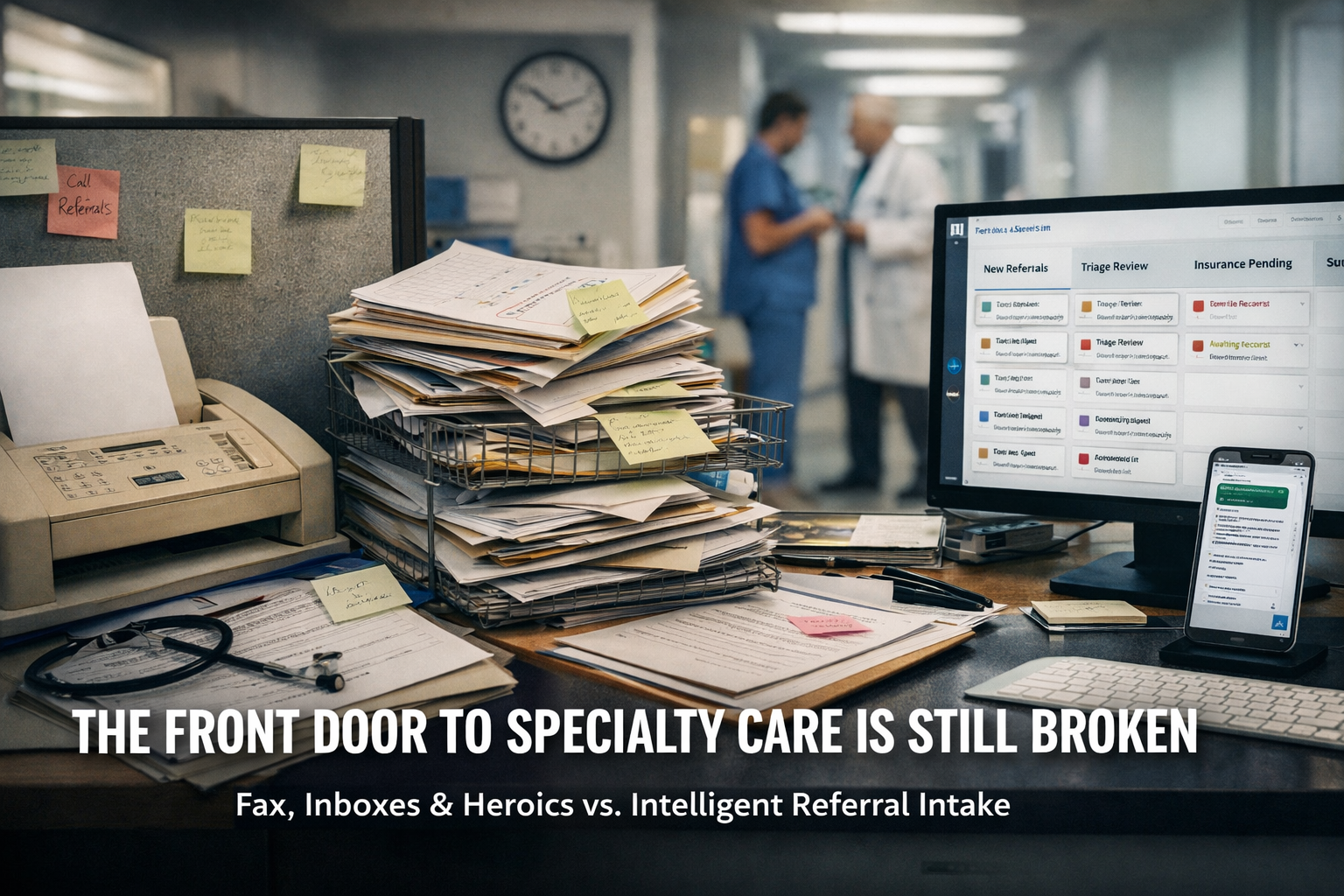
Fax, Inboxes, and Heroics: Why the Front Door to Specialty Care Is Still Broken
In specialty care, everyone talks about access.
Faster access.
Better access.
More equitable access.
More coordinated access.
But very few organizations talk honestly about the place where access actually begins:
Referral intake.
That is a problem.
Because the moment a referral arrives, a clinic is not just receiving paperwork.
It is receiving:
a patient safety decision,
a scheduling decision,
a revenue-cycle decision,
a patient-experience decision,
and, often, a test of whether the organization can move faster than its own bottlenecks.
Yet in many specialty settings, that front door is still held together by fax machines, email inboxes, manual review queues, spreadsheet tracking, and staff heroics.
And the consequences are bigger than most people realize.
In one JAMA Network Open study, completion rates for selected tests and referrals were low across all visit modalities, ranging from 40% to 65%. In that same study, 58% of in-person orders and 43% of telehealth orders were completed within the designated timeframe. That is not just an efficiency issue. That is a loop-closure issue.
Triage adds another layer of risk. A PubMed-indexed study on referral-based triage found that decisions made from referral information matched post-consultation assessment in 54% of cases, and urgency was underestimated in 27% of cases. When intake is inconsistent, “first come, first served” is not neutral. It can be unsafe.
And despite years of digital transformation talk, the referral channel itself is still often stubbornly manual. One provider survey cited by Phreesia found that 56% of providers still send referrals via traditional fax. In other words, the industry may be digital in parts, but the front door is still frequently analog.
That is why specialty-care leaders need to stop treating referral intake like clerical overhead.
It is not overhead.
It is an operating system.
The Real Issue Is Not Fax. It Is Latency.
Fax gets blamed for everything, but fax is not the whole problem.
The bigger problem is what happens after the referral arrives.
How long does it sit untouched?
How many people touch it before action happens?
How often is key information missing?
How often does staff re-enter data that already exists on the page?
How often does an urgent patient wait in the same queue as a routine one?
How often does eligibility get checked too late?
How often does the patient hear nothing for days?
That is where leakage happens.
That is where delays happen.
That is where burnout happens.
That is where referring-provider trust starts to erode.
The modern question is not:
“How do we eliminate fax overnight?”
The modern question is:
How do we convert unstructured referrals into structured action as fast as possible, with the right safeguards in place?
That is a very different problem.
And it is a much more solvable one.
Referral Intake Should Work Like a Real Care-Access Pipeline
A modern specialty referral workflow should not begin when a staff member finally opens the inbox.
It should begin the moment the referral arrives.
That means the system needs to do six things well:
1. Capture everything into one queue
Fax, email, portal submissions, uploaded documents, and EMR-originated intake should land in a single operational view rather than being scattered across channels.
One intelligent queue is better than three disconnected inboxes.
2. Turn documents into usable data
A referral packet is not useful just because it arrived.
It becomes useful when the following are extracted into a structured form people can act on:
demographics,
insurance,
diagnoses,
medications,
labs,
and referring-provider details.
3. Triage for urgency and fit
Not every patient should move through the same workflow at the same speed.
Some need:
nurse review,
missing records first,
routing to a subspecialty queue,
or rapid action.
The point of triage is not to remove humans.
It is to make sure humans spend time where judgment matters most.
4. Verify financial readiness upstream
If eligibility, deductible, coverage, network status, or authorization needs are discovered late, the clinic has already lost time.
Insurance verification belongs inside intake, not downstream of it.
5. Engage the patient before staff have to chase them
The best intake systems do not wait for a coordinator to manually call every patient before progress begins.
They:
trigger early outreach,
collect documents,
request forms,
and show status.
6. Close the loop into the EMR and reporting layer
If intake lives outside the chart and outside analytics, the organization never gets compounding value.
The goal is not just faster intake.
The goal is a measurable, auditable, connected workflow.
Why This Matters to More Than Operations Teams
When referral intake is broken, everyone pays for it.
Patients experience:
silence,
confusion,
delay,
and duplicated effort.
Staff experience:
interruptions,
repetitive data entry,
queue anxiety,
and the pressure of trying to catch every exception manually.
Providers experience:
poor visibility,
inconsistent prioritization,
and delayed access for the patients who may need them most.
Leadership experiences:
leakage,
slower growth,
weaker referral conversion,
and an incomplete picture of where the front-end process is failing.
This is why referral intake belongs in the same strategic conversation as:
patient access,
revenue cycle,
and digital transformation.
Because that is what it is.
Not a side workflow.
Not a clerical nuisance.
Not a fax-room problem.
A strategic operating layer.
The Most Credible Use of AI in Specialty Care May Be Upstream, Not Downstream
A lot of healthcare AI conversation still revolves around:
note generation,
ambient documentation,
and clinical summarization.
Those categories matter.
But some of the most practical, measurable value may actually sit one step earlier in the patient journey.
Upstream.
At intake.
At the moment where:
unstructured documents become structured work,
urgency is surfaced,
missing information is identified,
and the right next action is determined before a staff member loses ten minutes figuring out what even arrived.
That is where AI can reduce administrative drag without pretending to replace clinical expertise.
And that is where the business case gets unusually clear:
less manual entry,
faster first touch,
fewer stalled cases,
better visibility,
better patient communication,
stronger conversion,
and better use of scarce staff time.
The Next Competitive Advantage in Specialty Care Is Not Just Better Scheduling
It is better intake.
The organizations that win in the next few years will not just be the ones with:
more providers,
or nicer portals.
They will be the ones that make the front door:
faster,
cleaner,
more visible,
and more intelligent.
They will know:
how long referrals sit untouched,
which referrals are aging,
where patients drop off,
which referring sources convert,
which cases stall on missing documentation,
which queues are overloaded,
and which operational fixes actually improve access.
That is not just process improvement.
That is strategic visibility into how care begins.
Final Thought
Every specialty clinic says it wants to improve access.
The real question is whether the referral workflow makes that possible.
Because if the front door is still built on:
scattered inboxes,
manual review,
delayed outreach,
and late-stage cleanup,
the organization is not really managing access.
It is reacting to backlog.
And backlog is not a strategy.
The future of specialty access will belong to the organizations that treat referral intake as a system worth:
designing,
measuring,
and modernizing.
Not because it is trendy.
Because it is too important not to.